.png)
The State of Carbon Dioxide Removal is a key knowledge partner to CDR2030. Its third and latest edition (June 2026) provides a robust evidence base and framework for analysis underlying the intitiative's 2030 Implementation Target, Activation Groups, and Actions to Accelerate CDR.
The State of Carbon Dioxide Removal provides CDR2030 with a clear, independent assessment of where the carbon removal field stands today, how far current trajectories fall short, and what system conditions must change to scale carbon dioxide removal responsibly by 2030.
Just as the Global Stocktake helps guide the COP Action Agenda by identifying the gaps between current progress and the goals of the Paris Agreement, the State of CDR plays a similar role for CDR2030. The report tells us where the field is, what is missing, and why the next five years matter. CDR2030 translates that diagnosis into collaboration, implementation, and concrete Actions that can help move carbon removal from early progress toward climate-relevant scale.
The State of CDR shows that carbon removal is entering a decisive phase. The field is no longer only a topic of climate modeling or long-term scenarios. It now includes real projects, companies, policies, public funding programs, voluntary purchases, standards, accounting systems, infrastructure needs, and public debate.
But the report also makes clear that the field is not yet on track.
Current deployment remains far below what is needed. Demand is still fragile. Policy support is uneven. MRV and accounting systems are still developing. Project pipelines are too small. Investment and demonstration activity are concentrated in a limited number of countries, companies, buyers, and methods. The next five years will be critical for determining whether CDR becomes a credible, responsible, and climate-relevant part of global climate action.
That is the context in which CDR2030 operates.
CDR2030’s role is to accelerate implementation using the State of CDR’s diagnosis to organize practical collaboration, identify priority interventions, and support Actions that can help bend the curve of CDR growth by 2030.
The State of CDR shows the central implementation challenge facing novel carbon removal: current activity and visible project pipelines remain far below both high-ambition climate pathways and CDR2030’s 2030 target. Closing that gap will require more than technology development — it will require stronger demand, policy support, finance, infrastructure, and coordinated action this decade.
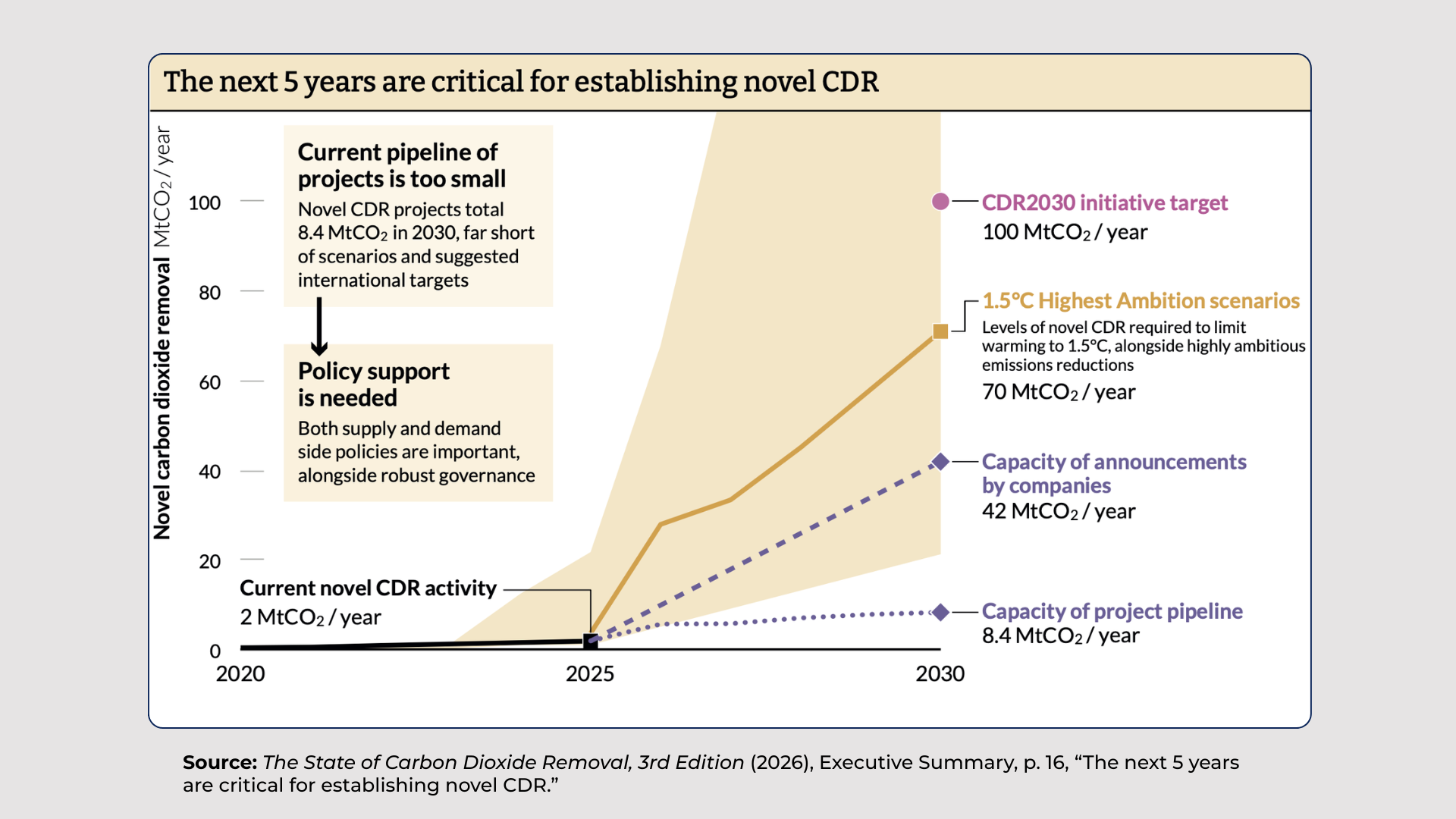
The State of CDR’s 3rd Edition directly illustrates the challenge CDR2030 is built around. The current visible project pipeline for novel CDR reaches only a small fraction of what would be needed by 2030 under high-ambition pathways. The report also shows CDR2030’s 100 MtCO₂/year novel CDR target alongside current activity, the project pipeline, company announcements, and 1.5°C highest-ambition scenarios.
This is the central CDR2030 implementation gap.
The target is not a forecast of where the field is already headed. It is an organizing milestone designed to mobilize the policy, demand, finance, infrastructure, trust, and deployment conditions needed to change the trajectory.
The State of CDR helps show why such a target is necessary. CDR2030 is designed to help organize the response.
The State of CDR provides the evidence base for CDR2030’s theory of change. Its findings show that the challenge is not only to develop better carbon removal technologies, but to build the demand, policy, infrastructure, finance, trust, and implementation capacity needed for responsible scale. The following eight findings help explain why CDR2030 is organized the way it is — and why action before 2030 matters.
1. CDR is necessary, but emissions reductions remain the priority
The report is clear that carbon dioxide removal is needed alongside rapid emissions reductions. CDR is not a substitute for mitigation. It is a necessary complement for counterbalancing residual emissions and, eventually, helping achieve net-negative emissions. For CDR2030, this means carbon removal must be scaled with integrity and in ways that reinforce, rather than weaken, the broader transition.
2. Novel CDR is growing, but from a very small base
Novel CDR methods are expanding, but current levels remain tiny compared with what high-ambition climate pathways require. The report shows that growth is real, but that present conditions are not enough to deliver the scale needed by 2030. For CDR2030, this reinforces the importance of near-term implementation. The field needs more than long-term ambition. It needs concrete actions that can expand deployment, demand, policy support, project pipelines, and learning-by-doing now.
3. Demand is fragile
The report identifies demand as a critical condition for closing the CDR gap. Without credible expectations of future demand, suppliers cannot confidently invest, projects cannot advance, and learning-by-doing remains limited. This directly informs CDR2030’s Demand Mobilization objective. CDR2030 aims to help expand and diversify the sources of demand for CDR, including corporate purchasing, public procurement, sectoral coalitions, value-chain insetting, and future compliance-linked demand.
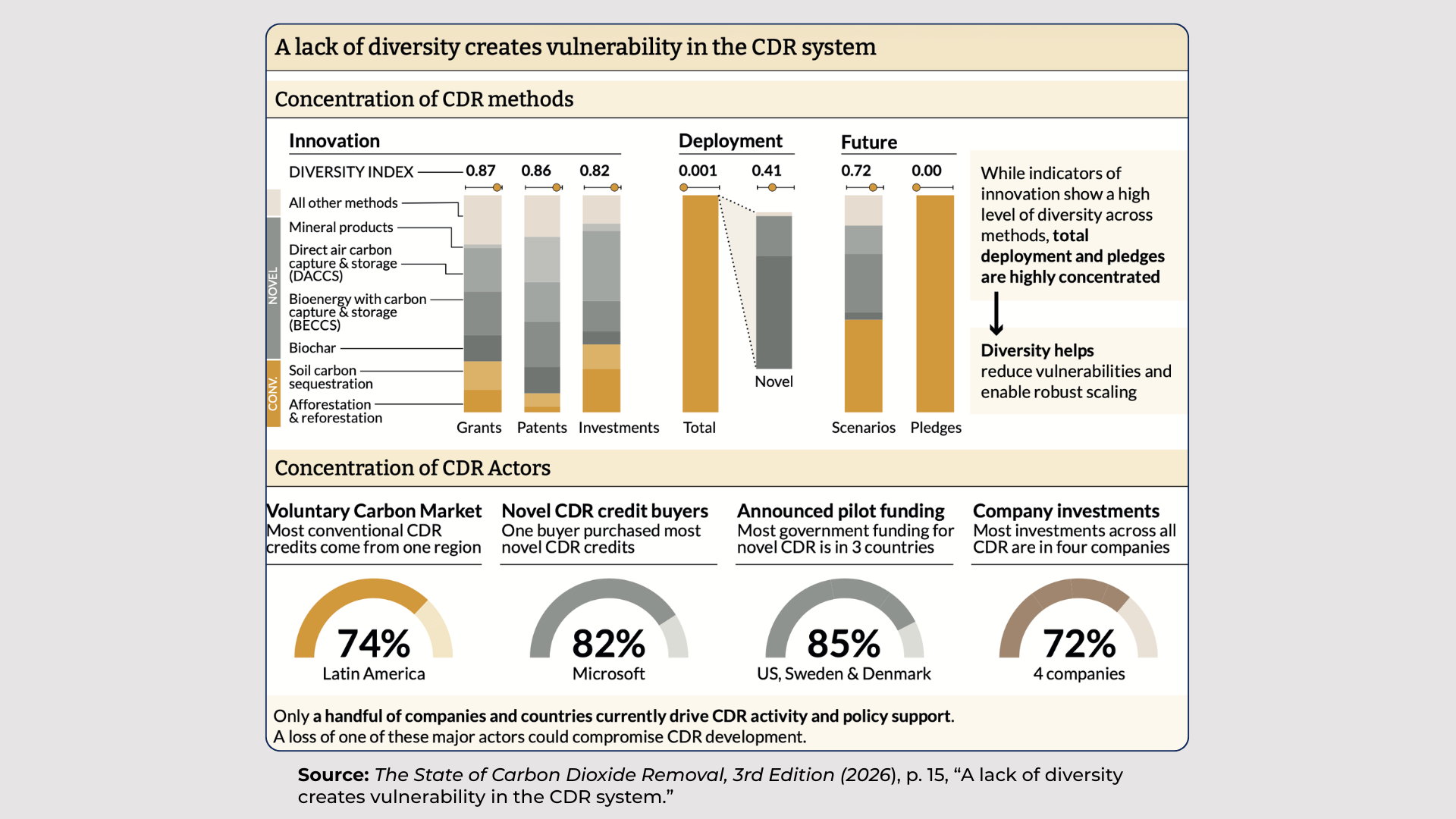
This finding is central to CDR2030’s theory of change. CDR scale-up requires more buyers, more geographies, more suppliers, more policy models, more implementation settings, and more pathways for participation. CDR2030’s membership network and Activation Groups are designed to broaden the ecosystem of actors capable of contributing to CDR implementation.
5. Policy support must become more complete and durable
The report shows that policy support is essential for responsible CDR scale-up. Supply-side support, such as R&D funding and demonstration support, matters. But demand-side policy, public procurement, MRV rules, incentives, permitting, accounting systems, and long-term governance frameworks are also needed. This directly informs CDR2030’s Policy Activation objective. The goal is to help move CDR policy from exploration toward implementation.
6. CDR must move into real-world systems
Scaling CDR is not only about improving technologies. It requires facilities, infrastructure, finance, workforce, business models, supply chains, public agencies, industrial users, and place-based deployment contexts. This directly informs CDR2030’s Industrial Integration work. CDR must become part of real economic and physical systems: agriculture, cement, concrete, mining, wastewater, biomass, ports, cities, public infrastructure, construction materials, and other sectors where carbon removal can be deployed or enabled.
7. Trust systems are essential
The report emphasizes the importance of measurement, reporting, verification, durability, accounting, transparency, standards, and governance. Without credible trust infrastructure, carbon removal cannot scale responsibly. For CDR2030, this means Actions should not only aim to generate tonnes. They should also help strengthen the systems that make tonnes credible, comparable, durable, and accountable.
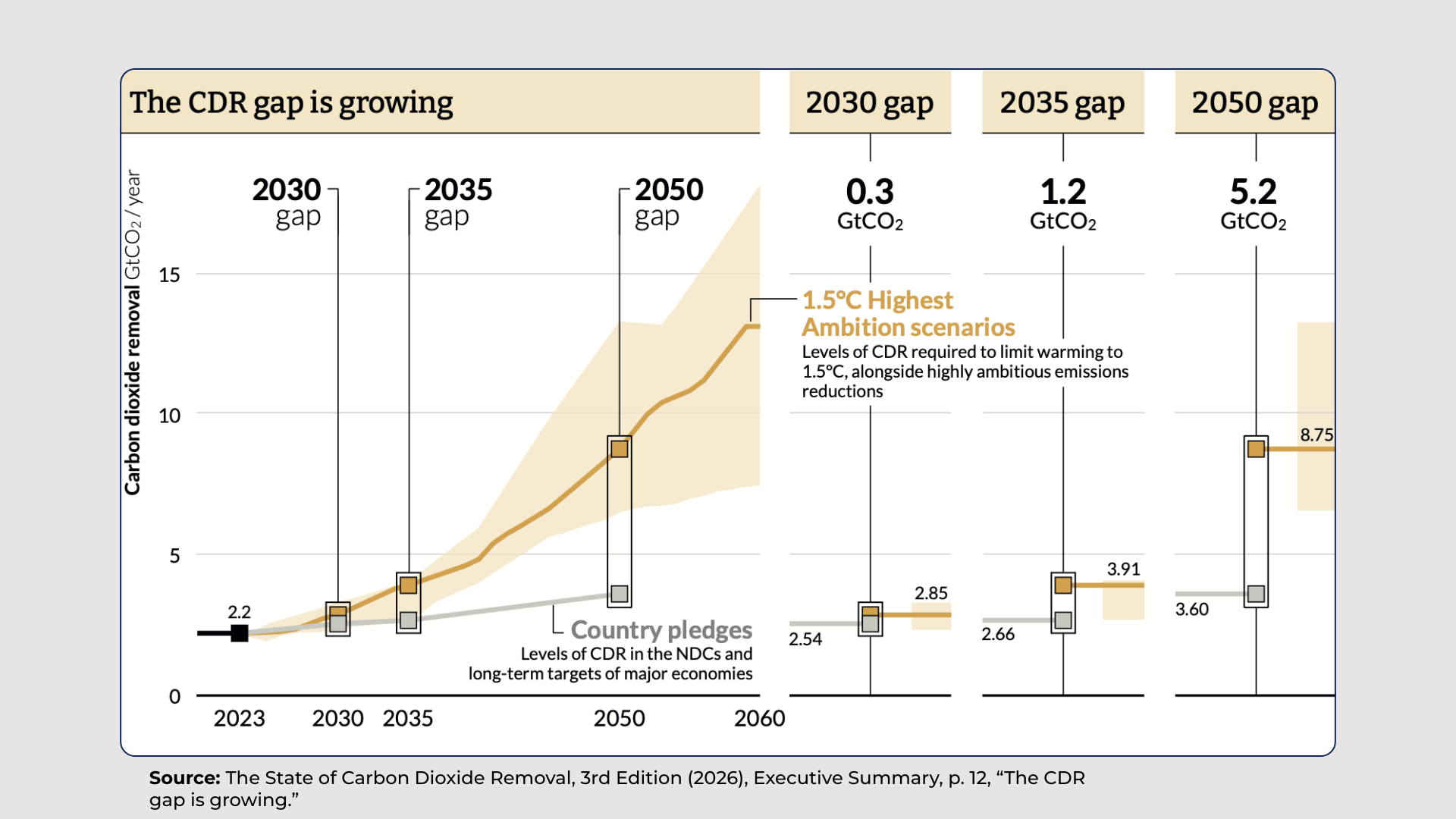
The State of CDR shows that the gap between country pledges and Paris-compatible CDR levels grows rapidly after 2030. This matters because deployment is gradual. Policies, markets, infrastructure, standards, and projects take years to mature.
CDR2030 is organized around Activation Groups: practical workstreams where members collaborate, learn, identify opportunities, and develop Actions to Accelerate CDR. The State of CDR helps explain why these Activation Groups are needed.
State of CDR shows that future CDR deployment depends on stronger and more credible demand. Today’s demand remains limited, fragile, and concentrated. CDR2030 responds by supporting Actions that can expand, diversify, and strengthen demand for CDR. These may include buyer coalitions, public procurement, advance purchase commitments, value-chain insetting, and future compliance-market readiness.
State of CDR shows that policy and governance are essential to responsible scale. Markets alone are unlikely to create the level, durability, and integrity of demand and deployment needed for climate-relevant CDR. CDR2030 responds by supporting Actions that advance public policy, regulation, procurement, incentives, MRV rules, planning frameworks, CDR targets, permitting pathways, and other governance tools.
State of CDR shows that CDR must move into real-world deployment contexts. Scaling requires infrastructure, workforce, project development, logistics, finance, business models, and integration with existing industries and value chains. CDR2030 responds by supporting Actions that embed CDR into sectors, facilities, products, supply chains, and infrastructure systems where implementation can actually happen.
The report also shows that the speed of growth required to attain CDR2030’s 100 Mt novel CDR target is highly ambitious, but not without precedent.
.png)
CDR2030’s 2030 Target is intentionally ambitious. The State of CDR makes clear that reaching 100 MtCO₂/year of novel CDR by 2030 would require extremely rapid growth.
But the report also places that ambition in context. Historical examples of technology diffusion show that very fast growth is possible when the right conditions align. The point is not that carbon removal will automatically follow the path of solar, electric vehicles, batteries, or other fast-growing technologies. It will not.
The point is that growth curves can change when markets, policy, investment, infrastructure, institutions, and public purpose begin to reinforce each other.
That is what CDR2030 means by bending the curve.